Monday, March 15, 2010

The Buried Life

Last week, a new series on MTV called The Buried Life, had its finale. It's a show about 4 young adult males who go on an adventure trying to cross things off their list of 100 thing they want to do before they die. Every time they cross something off their list, they help a stranger cross something off theirs. It's actually kind of touching.


It reminded me of the green light in The Great Gatsby. No, technically the list is not only one thing they desire most in life, but it does connect in a way. I think the show sends out a great message, if you put your mind to it, you can do anything you want. Their list is composed of small things, not anything like 'find a cure for cancer' or 'change the world'.  Most of the things they do are not hard to accomplish, showing that you can be a better person with taking small risks everyday. It makes me want to make my own list of thing to do before I die. Do you have one?

What do you want to do before you die?


(image via: http://www.mtv.com/shows/buried_life/series.jhtml) [also the Buried Life website]

Tuesday, March 2, 2010

The American Dream

Since we have been talking a little about social class in America, I decided to look back at some work I did last year. For my Sophomore English class, I chose to read Class Matters by the New York Times, for one independent reading book. I really enjoyed it because it wasn't your typical book. There were many New York Times writers that contributed to the book, and each chapter was about real people living in America today. Every chapter invited you in to a strangers home, and they told you about their own life, and their own American Dream.

One that stuck out to me was said by a white woman, Karen Handel, who lives in a wealthy town in Georgie. She said:

“What is the American Dream? It’s to have a house of your own, the biggest house you can afford, on the biggest lot you can afford, with a great school for your kids, a nice park to spend Saturday afternoon with your kids in, and deep in amenities that get into the trade-offs with traffic”.

I think Karen's personal American Dream is kind of stereotypical for rich whites. Personally, I believe that forming an American Dream is very difficult. Because everyone is different in their own way, everyone's American Dream should be different. What do you think about Karen's American Dream? What is your American Dream?

For more information, check out the NYT page for Class Matters.

(image via: http://rgr-static1.tangentlabs.co.uk/images/bau/97808050/9780805080551/0/0/plain/class-matters.jpg)

Monday, March 1, 2010

Art

After today's discussion about the arts and how somebody can make a living off of it, I came across this quote:

“Every child is an artist. The problem is how to remain
an artist once he grows up" --Pablo Picasso

The word problem really stuck out to me. If a child is interested in art, I think it is important to continue that hobby. I think this shows a common situation: Mom and Dad don't want their daughter to become an artist because they want whats best for her. Well, perhaps art is what's best. No, usually you won't make a lot of money, but you're doing what makes you happy. I think it would be better for someone interested in art to pursue it, rather than going into accounting (or some other common finance job) and throwing away their art talent. Like Mr. O'Connor said today, making a living doesn't necessarily mean making money. Do you think there is a 'problem' with growing up and being an artist?

(image via: http://www.flickr.com/photos/38338230@N06/3676263520/)

Sunday, February 7, 2010

Winter vs Summer Olympics


  VS


As we all know, the 2010 Winter Olympics are just around the corner. Earlier this week we discussed why certain sports that both men and women play, almost always the men teams always get more recognition. This sparked this question: which is more popular, the Winter or Summer Olympic games? Why? I personally believe that the summer Olympics always get more attention than the winter games. I think it is because people usually have more free time in the summer and enjoy watching sunny outside sports. I also really like the winter Olympics, but I feel that there isn't such a big hype about them. The only time I remember being really excited about the Winter games is when they were in Salt Lake City in 2002. I remember watching the Olympic torch march down Sheridan road which I think made me interested in those Olympics. Overall, I think the Winter games have more interesting sports, but Summer games have the 'popular' sports like Track and Field, Swimming, and Gymnastics. Which one do you prefer? Why?


(images via http://www.skirebel.com/magazine/wp-content/uploads/2009/12/2010-vancouver-logo.png and http://sharealogo.com/wp-content/uploads/London_Olympics_2012_ai.png)

Sunday, January 10, 2010

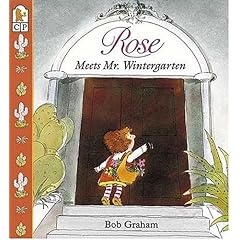
Rose Meets Mr. Wintergarten


One of my favorite children's book is called Rose Meets Mr. Wintergarten by Bob Graham. It's a nice story about a young girl you accidentally throws her basketball over the fence to her grim neighbor, Mr. Wintergarten, backyard . Other children tell Rose that Mr.Wintergarten eats kids and has a wolf as a dog, so nobody ever goes over there. Throughout the illustrations, the reader can see the dark grey colors of Mr. Wintergarden's house in the background behind Rose's colorful home. I just reread it and caught something that I hadn't noticed as a child, Rose's last name is Summers. And the mean neighbor is named Mr. Wintergarten. Summer vs. winter, nice vs. evil. When one thinks of summer, they mostly think of nice and warm surroundings. However when you think of winter, you think cold and dark. Now this may not be so "secret" but I think it is interesting to see how the author depicted the names with the matching personality. As a child, they were just names to me. But now, I feel like I have a better understanding of the characters and can accurately analyze them. Another message is that you can't always judge someone without getting to know them. Mr. Wintergarten seems bitter at first, but when people start paying attention to him, he warms up and becomes a very friendly man. This is a common case of "don't judge a book by it's cover".

(image via http://ecx.images-amazon.com/images/I/61XY3FV624L._SL500_AA240_.jpg)

The Best Way to Study...


Right now we all find ourselves amidst studying for finals. While I'm sitting here typing this, I find myself surrounded by a 4 month supply of math note sheets, homework, and tests spread all over my dining room table. Over the years many teachers have informed us about the most important study skills: prioritizing, time management, concentrations. And they also informed us of ones to avoid: cramming, and procrastinating. I have my ways in which I like to study, but I don't know if they are the most effective. I always ask myself after finals, did I study right? But is there a right way to study? I guess studying is different for each person because everyone knows what works for them. For example, I really find it helpful to do a LOT of review problems, going over old tests, and looking back on notesheets. This only helps me for math and science, but for english and history I usually review everything we've done in class. For this specific class, I liked how we were given the prompt so we could write down our ideas before the final, so we are not at a loss of words during the actual exam. What are your favorite ways to study?

(Image via http://www.flickr.com/photos/44124412272@N01/199135513/)

Saturday, January 9, 2010

Happiness


What makes a person happy? I was reading this article in the New York Times titled, "The Happiest People". The article stated three different ways that rank countries by happiness. The World Database of Happiness (lists countries in order of happiness based on surveys), tracking "happy life years" (scholars that calculate the self-reported happiness from the World Database of Happiness with life expectancy), and Happy Planet Index (combines happiness with longevity and environmental impact), are ways to check out America's happiness. Out of these three lists, the US ranked 14th, 19th, and 114th respectively. But I had to ask myself, are these ways of calculating happiness truly accurate? Do you think people can simply fill out a survey and then scholars can tell if the country is happy? I personally believe that a survey does not do justice to the whole country. I guess what I am saying is that I disagree with these rankings and the ways in which they created them. I don't think happiness is has anything to do with longevity or environmental impact. So, what do you think? How do we, as Americans, measure happiness?

(Image via http://media.photobucket.com/image/happy/boj_ana/happy.jpg)