Sunday, January 10, 2010

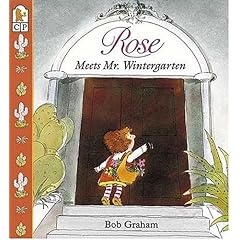
Rose Meets Mr. Wintergarten


One of my favorite children's book is called Rose Meets Mr. Wintergarten by Bob Graham. It's a nice story about a young girl you accidentally throws her basketball over the fence to her grim neighbor, Mr. Wintergarten, backyard . Other children tell Rose that Mr.Wintergarten eats kids and has a wolf as a dog, so nobody ever goes over there. Throughout the illustrations, the reader can see the dark grey colors of Mr. Wintergarden's house in the background behind Rose's colorful home. I just reread it and caught something that I hadn't noticed as a child, Rose's last name is Summers. And the mean neighbor is named Mr. Wintergarten. Summer vs. winter, nice vs. evil. When one thinks of summer, they mostly think of nice and warm surroundings. However when you think of winter, you think cold and dark. Now this may not be so "secret" but I think it is interesting to see how the author depicted the names with the matching personality. As a child, they were just names to me. But now, I feel like I have a better understanding of the characters and can accurately analyze them. Another message is that you can't always judge someone without getting to know them. Mr. Wintergarten seems bitter at first, but when people start paying attention to him, he warms up and becomes a very friendly man. This is a common case of "don't judge a book by it's cover".

(image via http://ecx.images-amazon.com/images/I/61XY3FV624L._SL500_AA240_.jpg)

The Best Way to Study...


Right now we all find ourselves amidst studying for finals. While I'm sitting here typing this, I find myself surrounded by a 4 month supply of math note sheets, homework, and tests spread all over my dining room table. Over the years many teachers have informed us about the most important study skills: prioritizing, time management, concentrations. And they also informed us of ones to avoid: cramming, and procrastinating. I have my ways in which I like to study, but I don't know if they are the most effective. I always ask myself after finals, did I study right? But is there a right way to study? I guess studying is different for each person because everyone knows what works for them. For example, I really find it helpful to do a LOT of review problems, going over old tests, and looking back on notesheets. This only helps me for math and science, but for english and history I usually review everything we've done in class. For this specific class, I liked how we were given the prompt so we could write down our ideas before the final, so we are not at a loss of words during the actual exam. What are your favorite ways to study?

(Image via http://www.flickr.com/photos/44124412272@N01/199135513/)
Saturday, January 9, 2010

Happiness


What makes a person happy? I was reading this article in the New York Times titled, "The Happiest People". The article stated three different ways that rank countries by happiness. The World Database of Happiness (lists countries in order of happiness based on surveys), tracking "happy life years" (scholars that calculate the self-reported happiness from the World Database of Happiness with life expectancy), and Happy Planet Index (combines happiness with longevity and environmental impact), are ways to check out America's happiness. Out of these three lists, the US ranked 14th, 19th, and 114th respectively. But I had to ask myself, are these ways of calculating happiness truly accurate? Do you think people can simply fill out a survey and then scholars can tell if the country is happy? I personally believe that a survey does not do justice to the whole country. I guess what I am saying is that I disagree with these rankings and the ways in which they created them. I don't think happiness is has anything to do with longevity or environmental impact. So, what do you think? How do we, as Americans, measure happiness?

(Image via http://media.photobucket.com/image/happy/boj_ana/happy.jpg)

Thursday, January 7, 2010

Young Girl to Woman


During Winter break, my mom and I ventured off to NYC for a short weekend trip. One day we went to the Metropolitan Museum of Art (aka the Met) and went to an exhibit called American Stories. I was excited because I thought it would be cool to see stories of Americans represented in art and relate it to this class somehow. I was particularly struck by one painting titled "Story of Golden Locks" by Seymour Joseph Guy. It was painted in 1870 and the exhibit called this era, "Stories of War and Reconciliation". The painting depicts a girl reading Goldilocks and the Three Bears to her two young brothers. What I did not catch in the painting was the little doll stuffed in the box on the chair. By reading the summary next to the painting, I read that this showed her advancement from girlhood to womanhood. I thought this connected well into our Women and Children unit we are studying now. But by stuffing her doll into the box shows that she is ready to take on a role as a woman and later on becoming a mother.  I really like how Guy's simple painting has a sentimental feel for young girls who want to assume the role of a woman. What do you think about this painting? When do you think a girl takes on the role to becoming a woman, is it as simple as tucking away your toys and games?

(image via http://www.metmuseum.org/special/americanstories/objectImages/TT.3.14.EL.jpg)

Tuesday, January 5, 2010

New Year's Resolutions


Every New Year's Eve my family goes around and shares our resolutions for the year. I've never really given much thought to my resolution. It usually ends up that I want to clean my room more often or eat more vegetables, nothing out of the ordinary. I searched New Year's Resolutions and found this list of popular resolutions according to www.usa.gov.
  • lose weight
  • manage debt
  • save money
  • get a better job
  • get fit 
  • get a better education
  • drink less alcohol
  • quit smoking
  • reduce stress
To my knowledge, I've heard that most people who make resolutions do not follow through. Then what's the point? To further prove this, a website confirms that out of a group of 3000 people, only 12% followed through with their resolution. I know that this experiment does not even compare to the number of people in our country but it still is pretty shocking. I never know where to start when coming up with a resolution, but here is one I hope to keep: do not get behind on blogging! What do you think about New Year Resolutions? Did you come up with one this year, if so, what is it?!